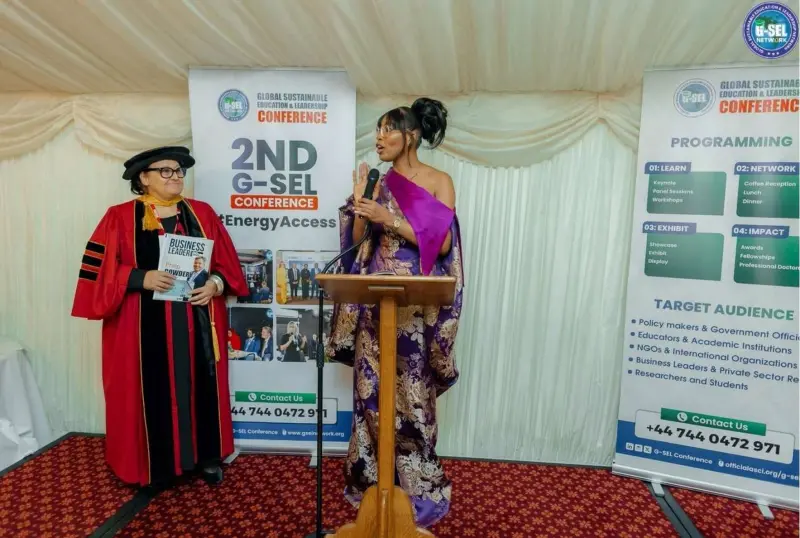
London, 3rd February 2026 - Global Sustainable Education & Leadership (GSEL) Network is pleased to announce the publication of its latest report, Sustainable Education & Leadership in Energy Access. The report calls for innovative solutions, deeper partnerships, and immediate actions to accelerate cleaner energy access, particularly in the developing world, to support sustainable development and advance SDG7’s aim for ‘affordable, reliable, sustainable and modern energy for all’ by 2030.
The report highlights the results of GSEL’s latest research and initiatives discussed at its most recent annual conference at the end of last year, where over 200 delegates, including a broad range of policy experts gathered in London to discuss the intersection of innovation, sustainability, and equity in energy access.
The headline initiative from the conference and report is that GSEL Network, in partnership with the Energy Transitions Commission (ETC), has committed to developing scalable pathways for the "Cleaner Energy Rollout for Africa," aimed at addressing energy poverty and promoting renewable energy access across Sub-Saharan Africa.
This broad-ranging plan promises to reduce emissions and increase cleaner energy access to millions of households, creating green jobs and supporting local manufacturing hubs for energy technologies, while also fostering economic growth and resilience in underserved communities through sustainable infrastructure development.
Key Report Findings and Calls to Action:
- Urgent Action Required: Immediate deployment of localized, cleaner energy solutions needed to address energy access gaps in the Global South.
- Commitment to Partnerships: Collaborations between governments, private sectors, and civil society required to accelerate energy transitions.
- Financing the Future: Innovative financial models are needed to de-risk and fund scalable energy projects in low-income regions.
- Policy Leadership: Governments need to prioritise inclusive and equitable policies that support cleaner energy growth while ensuring energy security.
- Empowering Local Communities: Capacity-building resources are required to empower communities, ensuring that energy access drives sustainable development.
The G-SEL report spotlights key challenges in global energy access, particularly for underserved regions. One of the pivotal areas focused on is how distributed energy systems, such as solar and battery technologies, can reshape energy systems, especially in developing nations. It also covers how technology as a tool for enhancing energy resilience, for decentralised policies that boost access to cleaner energy.
Another major theme is the financing of the transition to cleaner energy, calling for experts to explore blended finance mechanisms that combine public and private investments. These models are critical for de-risking large-scale energy projects in low-income regions, ensuring that capital flows into necessary infrastructure for sustainable development.
Policy leadership is another priority, with stress on the need for coherent frameworks that balance decarbonisation goals with energy security. The report also emphasises the importance of inclusive governance structures that can integrate marginalized communities into the energy transition, fostering economic resilience.
The report is the culmination of GSEL’s latest research and the extensive deliberations at the G-SEL Annual Conference in November 2025, which was held at the House of Lords and the University of East London, and included workshops, plenary panels, and innovation pitches.
Notable sessions included expert-led discussions on youth empowerment, circular economy principles, and government policy frameworks for sustainable energy transitions. The conference also featured global perspectives, including insights from experts in the UK, Fiji, Zambia, and the USA, which enriched the dialogue on energy access.
G-SEL’s Annual Conference in November 2026, will also take place at the House of Lords and if you are interested in attending, please contact G-SEL on their website - https://gselnetwork.org/contact-us/
G-SEL's Partnerships Director, Joy Osomiamhe-O, commented: “Energy access is not just about infrastructure; it is about empowerment, opportunities, and connections that enable individuals and communities to thrive. It's about ensuring that people have the resources they need to improve their lives, build sustainable futures, and participate fully in the global economy.
The resolutions and partnerships formed during this conference and advocated in our report lay the foundation for transformative changes that will empower millions of people around the world, particularly those in underserved regions. By providing access to clean, reliable energy, we open doors to education, healthcare, economic growth, and a better quality of life, while also addressing climate change and fostering resilience in the face of global challenges.”
About G-SEL: The G-SEL Network is a Community Interest Company (CIC) dedicated to advancing sustainable development through education, energy, and environmental action. Founded in 2024, the network seeks to bridge the gap between the Global North and South by fostering global partnerships and policy innovations. With a focus on SDG7, G-SEL empowers communities by equipping them with the knowledge, resources, and frameworks needed for sustainable energy transitions. Through its conferences, workshops, and collaborative partnerships, G-SEL is committed to creating lasting, positive change for communities worldwide. For more information, visit www.gselnetwork.org
For further information please contact:
Sapience Communications
Richard Morgan Evans, Fergus Atkinson, Padma Sarojar
Email: [email protected]
Telephone: +44 (0)20 3841 7610