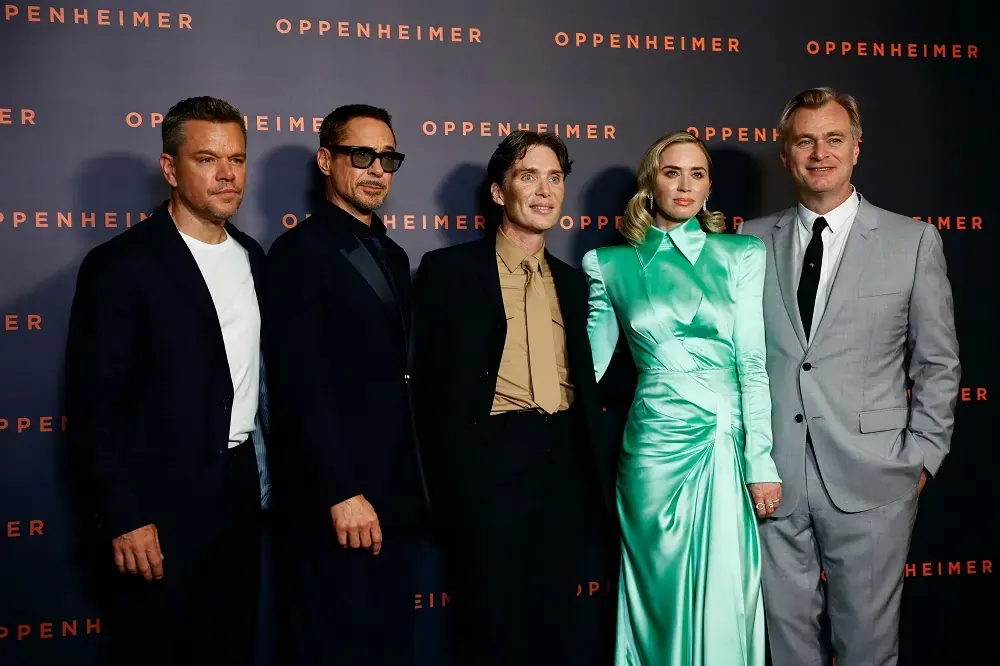
LONDON (Reuters) -Historical drama “Oppenheimer”, one of last year’s highest- earning movies, led nominations for the BAFTAs with 13 nods on Thursday, but the omission of some favourites from Britain’s top movie honours surprised fans.
“Oppenheimer”, about the making of the atomic bomb, was followed by sex-charged gothic comedy “Poor Things”, with 11 nominations for the BAFTA Film Awards, which will be handed out at a ceremony next month.
Martin Scorsese’s “Killers of the Flower Moon”, about the murders of members of the Osage Nation in the 1920s, and “The Zone of Interest”, which tells the story a family living next to Auschwitz, both received nine nods.
“Oppenheimer”, “Poor Things” and “Killers of the Flower Moon” will compete for the top prize, best film, alongside courtroom drama “Anatomy of a Fall” and “The Holdovers”, a comedy set in a boys’ boarding school.
Pink-themed phenomenon “Barbie”, the highest grossing film of 2023, missed out in that category but got five nominations overall.
“It has been an outstanding year for film-making as represented by the 38 films nominated today,” Anna Higgs, chair of BAFTA Film Committee, said in a statement.
“They showcase ambitious, creative and hugely impressive voices from independent British debuts to global blockbusters, from complex moral issues through to joyful journeys of self-discovery. They all ultimately explore human connection.”
Based on the 2005 biography “American Prometheus” by Kai Bird and Martin J. Sherwin, “Oppenheimer” focuses on J. Robert Oppenheimer, taking audiences back to when the American theoretical physicist oversaw the creation of the atomic bomb during World War II.
An awards season favourite, it has picked several prizes already, including five Golden Globes.
Cillian Murphy was recognised in the BAFTA leading actor category for his portrayal of Oppenheimer. Fellow cast mates Robert Downey Jr. and Emily Blunt were also nominated in the supporting acting categories. Christopher Nolan was recognised for best director and adapted screenplay.
“I couldn’t be happier that the British Academy recognised so many of my collaborators on ‘Oppenheimer’, especially Chris Nolan,” Murphy said.
“Working on the film was an experience I’ll never forget.”
‘SHOCK’
“Poor Things” received a leading actress nod for Emma Stone, who has already pick up awards for her performance, as well as recognition in the outstanding British film and adapted screenplay categories.
Other leading actress contenders include Margot Robbie for “Barbie”, Carey Mulligan for “Maestro”, Fantasia Barrino for “The Color Purple”, Vivian Oparah for “Rye Lane” and “Anatomy of a Fall”‘s Sandra Hüller, who was also nominated in the supporting actress category for “The Zone of Interest”.
Golden Globe winner Lily Gladstone, considered a strong contender for the best actress Oscar, was not nominated for “Killers of the Flower Moon”, neither was Scorsese as director.
Various media outlets described Gladstone’s omission as a “shock”.
Alongside Murphy, Bradley Cooper of “Maestro”, Barry Keoghan for “Saltburn”, Colman Domingo for “Rustin”, Paul Giamatti of “The Holdovers” and Teo Yoo for “Past Lives” make up the leading actor nominees.
None of the best director contenders has previously won the award, and four out of the six were first-time director nominees: Jonathan Glazer for “The Zone of Interest”, Alexander Payne for “The Holdovers”, Andrew Haigh for mystery drama “All of Us Strangers” and Justine Triet for “Anatomy of a Fall”.
Triet is the only woman on the list, with the omission of “Barbie” director Greta Gerwig raising some eyebrows.
“‘Barbie”s done incredibly well. It’s brilliant to see Greta nominated for (original) screenplay, for Margot and for Ryan to be nominated,” Sarah Putt, chair of BAFTA, told Reuters, referring to Ryan Gosling’s supporting actor nomination.
“It’s a very, very competitive year.”
Known as the BAFTAs (British Academy of Film and Television Arts), the awards ceremony takes place in London on Feb. 18.
For a factbox of nominations, please click here.
(Reporting by Marie-Louise Gumuchian; Additional reporting by Sarah Mills; editing by Christina Fincher, Barbara Lewis and Bernadette Baum)